Views: 136 Author: Site Editor Publish Time: 2026-06-20 Origin: Site
Fluid transfer in processing facilities carries massive stakes. When a transfer line fails, the damage extends far beyond temporary downtime. It introduces severe cross-contamination risks into your entire system. Product loss scales up rapidly during these events. Devastating recall liabilities often follow a contamination incident. Many buyers rely solely on an "FDA-approved" label when sourcing replacements. We must clarify this remains an incomplete strategy. Correct selection requires much deeper analysis. You must carefully align material science with specific plant conditions. You have to consider temperature extremes during operation. You must account for intense cleaning regimens. You need to map out exact spatial routing limitations. We designed this article to solve these precise challenges. It provides procurement teams and plant engineers a clear blueprint. We offer an evidence-based framework for evaluating reliable fluid transfer options. You will learn how to shortlist the best components safely.
Material dictates performance: Hose selection must map directly to fluid types (e.g., NBR for fats, EPDM for alcohols, PTFE for high-acid environments).
CIP resilience matters more than operating temps: An FDA high temperature wash rubber hose must survive aggressive Clean-In-Place (CIP) chemicals, not just the product temperature.
Fittings are the primary failure point: Sanitary, seamless couplings are non-negotiable to prevent bacterial harboring in "dead legs."
Compliance is a baseline, not a guarantee: Regulatory standards (FDA, NSF, USP Class VI) ensure non-toxicity but do not promise operational longevity under mechanical stress.
The "FDA-approved" label creates a common misconception in the industry. FDA compliance strictly dictates material purity and non-toxicity. Regulations like 21 CFR 177.2600 prevent toxic molecules from transferring into your food. They do not guarantee survival against mechanical wear. They ignore specific plant environments completely. A baseline standard simply ensures the material starts out safe.
You must verify deeper purity standards. Confirm the absolute absence of heavy metals. Reject products using toxic dyes or recycled plastics. Identify the required sub-certifications for your facility. NSF-51 covers food equipment materials specifically. NSF-61 applies directly to drinking water systems. USP Class VI covers pharmaceutical and high-purity biotech applications.
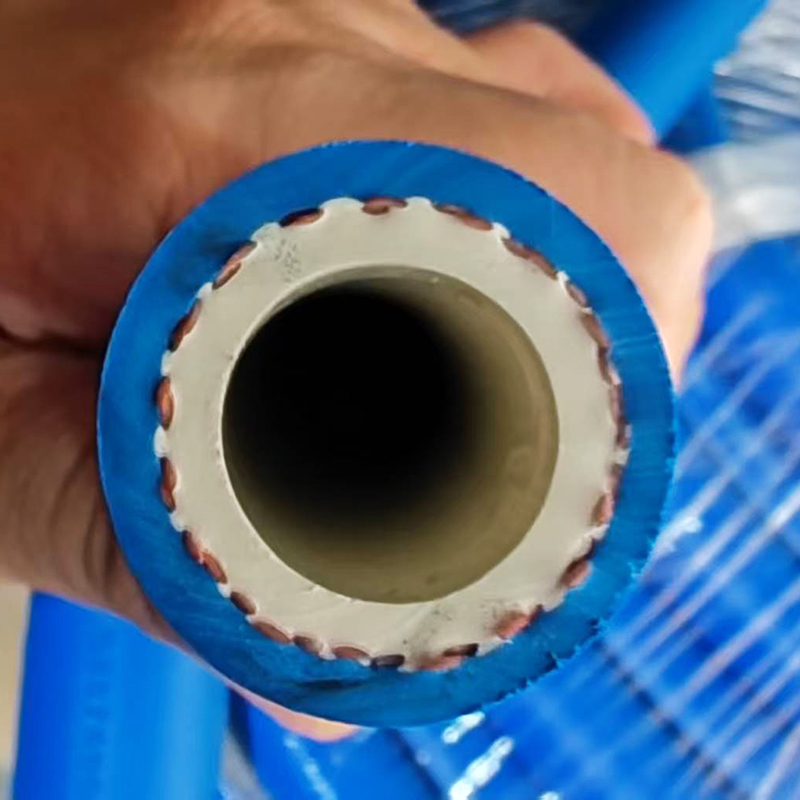
We recommend a system-wide evaluation approach. A food and beverage industrial hose represents a vital operational asset. It is never just a disposable consumable. You must evaluate the internal tube first. Then assess the reinforcement layer carefully. It handles severe vacuum and pressure demands. Finally, check the outer cover. It provides crucial environmental protection against physical abrasions and washdowns.
Material science forms the foundation of safe fluid transfer. Rubber hoses dominate many processing sectors. NBR (Nitrile) handles fatty and oily foods beautifully. It resists milk, cream, vegetable oils, and meats. Operating ranges typically sit around -30°C to +100°C. EPDM suits non-fatty applications perfectly. Breweries and wineries rely heavily on it. It moves beer, wine, and soft drinks safely. It also offers excellent weathering resistance outdoors.
Silicone hoses target extreme temperature variations. They operate flawlessly from -40°C to +260°C. They demand zero odor or taste transfer. You must differentiate between curing methods here. Platinum-cured silicone offers the highest purity. It leaves no chemical byproducts behind. It remains the standard for pharma and premium food. Peroxide-cured silicone costs less initially. However, it carries a distinct risk of chemical leaching.
PTFE (Teflon) handles ultra-aggressive processing environments. High-acid condiments and flavorings require PTFE. Extreme heat applications also demand it. Its non-stick surface simplifies sanitation significantly. PVC and Polyurethane (PU) serve different needs entirely. PVC offers a cost-effective choice for light duties. It handles cold water and non-fatty liquids. You must ensure it explicitly says "Phthalate-free" or "DEHP-free". PU resists severe abrasion exceptionally well. It easily conveys dry bulk solids like grains, flour, and sugar.
Material Type | Ideal Process Fluids | Temperature Range | Primary Advantage |
|---|---|---|---|
NBR (Nitrile Rubber) | Milk, cream, oils, fats | -30°C to +100°C | Excellent resistance to lipids and animal fats. |
EPDM Rubber | Beer, wine, soft drinks | -40°C to +120°C | High resistance to weathering and non-fatty liquids. |
Platinum-Cured Silicone | Pharmaceuticals, premium liquids | -40°C to +260°C | Zero taste/odor transfer; no leaching byproducts. |
PTFE (Teflon) | High-acid condiments, flavorings | -70°C to +260°C | Ultimate chemical resistance and non-stick surface. |
Polyurethane (PU) | Grains, flour, dry powder | -40°C to +90°C | Superior abrasion resistance for bulk solids. |
Process temperatures and cleaning temperatures differ drastically. Standard operating limits often sit far below extreme sanitation spikes. Clean-In-Place (CIP) and Steam-In-Place (SIP) cycles push materials to their limits. A system might process cold milk at 4°C. The same system then undergoes a 90°C steam wash. Materials must handle this rapid thermal shock without failing.
Chemical degradation poses massive hidden risks. Aggressive caustics attack inner linings during sanitation. Acidic sanitizers cause internal flaking over time. Flaking leads directly to catastrophic product contamination. You need a dedicated FDA high temperature wash rubber hose. It must withstand repeated chemical exposure. It should never suffer embrittlement or surface cracking over its lifespan.
Pressure ratings dictate system safety and longevity. You must calculate these values accurately.
Maximum Working Pressure (MWP): This defines the highest continuous pressure allowed for safe daily operations.
Burst Pressure: This represents the absolute physical limit. Exceeding this causes catastrophic rupture and hazardous spills.
Vacuum Rating: This measures the ability to resist collapsing during suction. Systems often require internal helical wire reinforcement here.
The danger of kinking destroys processing lines silently. Exceeding a minimum bend radius creates immediate flow restrictions. Pressure builds up rapidly behind the kink. Internal microscopic tears form at the stressed bend. Bacteria breed inside these hidden tears easily. They survive normal wash cycles because sanitizers cannot penetrate the micro-fissures.
Space constraints dictate proper assembly selection. Measure connection point distances carefully before ordering. Account for natural expansion and contraction under pressure. Assemblies often elongate slightly when pressurized. A tight layout causes premature stress failures at the fitting base. Allow sufficient slack to accommodate natural physical movements.
Weight and ergonomics affect daily manual operations. Operators manually handle many transfer lines on the floor. Brewery transfer lines require constant moving and repositioning. Assess the combined weight carefully. Add the dry component weight to the moving fluid weight. Heavy assemblies cause severe physical strain. Operator fatigue leads to dropping and damaging expensive sanitary fittings.
The weakest link principle applies strictly to processing lines. A premium food grade hose fails immediately if fittings remain improper. Seamless integration prevents catastrophic leaks. The connection point determines the overall safety of the assembly.
Sanitary design requirements are absolutely non-negotiable. Specify 304 or 316L stainless steel for all fittings. Tri-Clamps provide excellent sanitary connections globally. They resist aggressive corrosion effectively. They allow rapid disconnection for visual inspections.
Crimping always beats traditional banding methods. We strongly advocate for seamless, internally flush crimping techniques. Standard banding leaves tiny internal gaps. Product entrapment occurs quickly in these spaces. Bacterial growth follows immediately afterward. Flush crimping eliminates these dangerous internal steps entirely.
Verification ensures safety before deployment. Perform industry-standard integrity checks regularly. Hydrostatic testing confirms pressure limits hold securely. The HCST (Seven-Day Blue Fluid Test) proves sealing quality unequivocally. It guarantees a zero-leak, zero-dead-leg assembly. You can confidently deploy another food grade hose knowing it passes these stringent factory checks.
Hidden degradation destroys entire product batches unexpectedly. Internal lining wear remains invisible from the outside. Waiting for a visible burst leads to severe plant contamination. Reactive replacement strategies fail constantly in modern processing.
Routine inspection frameworks prevent sudden line failures. You must implement these checks actively:
Check outer covers for severe abrasions or exposed reinforcement wires.
Test the material for unnatural stiffness or sudden brittleness.
Examine the coupling ends for any micro-slippage or dampness.
Look for internal discoloration, odors, or subtle flaking.
Implement solid asset management protocols immediately. Move away from arbitrary calendar replacements. Do not rely on guesswork or visual memory. Implement tagging and tracking systems. RFID chips or color-coded collars work perfectly. Replace assets based on logged CIP cycles. Monitor flow rate drops closely. Track specific performance lifespans. This proactive approach ensures continuous purity across the plant.
Buying reliable components requires matching the core material to the specific fluid. You must verify CIP chemical resilience alongside temperature limits. You must ensure sanitary coupling integration to prevent dead legs. These factors create a secure, compliant transfer system.
Procurement teams should select highly capable suppliers. Look for vendors providing complete, tested assemblies. Ensure they provide full traceability documentation. Avoid buying bulk material to fit internally on the factory floor. Factory-tested assemblies reduce failure risks significantly.
Audit your current processing lines today. Look for compromised bend radii near pumps. Identify mismatched CIP materials. Replace aging equipment promptly to protect your product integrity.
A: No. Standard PVC contains plasticizers like phthalates. They can easily leach into food and beverages. Only specialized, phthalate-free, FDA-compliant PVC can be used safely in production.
A: Platinum-cured silicone uses an advanced curing process. It yields no chemical byproducts. This ensures zero odor or taste transfer. Peroxide-cured is cheaper but carries risks. It can leach trace organic acids into the fluid.
A: No. FDA approval for water does not mean the material resists fat degradation. Standard PVC or EPDM will degrade quickly. Dairy and oils require specific compounds like NBR (Nitrile).
A: It likely degrades due to CIP chemical incompatibility. A hose might be rated for food contact. However, it may lack the chemical resistance required for harsh caustic or acidic sanitizers.
A: Absolutely not. Standard garden hoses use low-grade plastics. They contain lead, heavy metals, and harmful plasticizers. They are prone to bacterial buildup. Never use them for drinking water or food processing.