Views: 123 Author: Site Editor Publish Time: 2026-06-16 Origin: Site
Transferring consumable products carries incredibly high stakes in any production facility. A single batch contamination can ruin your reputation instantly. Selecting the wrong conveying equipment often leads to costly production downtime. It also causes product spoilage from molecular migration and triggers severe regulatory penalties. You must shift your evaluation focus away from simple purchase prices. Instead, prioritize long-term operational integrity and consumer safety. Finding the right balance requires matching extreme cleaning environments against strict sanitary requirements. Clean-in-Place (CIP) and Sterilize-in-Place (SIP) protocols punish materials mercilessly. We designed this guide to help plant managers, process engineers, and procurement teams navigate these complexities. You will learn an evidence-backed framework to evaluate reliable assemblies. We will help you shortlist the safest components for your facility. This proactive approach ensures your production lines remain compliant and efficient.
Material dictates performance: Base material choices on the specific chemical makeup of the conveyed product (e.g., fats, acids, alcohols) to prevent flavor transfer and degradation.
Compliance is non-negotiable: True food-safety requires verifiable documentation (e.g., FDA, 3-A, NSF) to prove materials are free of leaching plasticizers.
Cleaning parameters matter most: Hoses often fail due to the extreme temperatures and harsh chemicals of CIP/SIP processes, not the daily operational load.
Fittings are the weak link: Seamless, crevice-free couplings are just as critical as the hose tube to prevent bacterial buildup.
Lifecycle tracking prevents recalls: Transitioning from reactive replacement to performance-based asset management reduces catastrophic failure risks.
The foundation of any safe transfer system lies in a strong material compatibility framework. You must align the core tube material directly with your specific food processing and beverage conveying needs. Different consumable products interact uniquely with industrial rubbers and plastics.
When handling dairy, meat poultry, or high-fat processing, specify NBR (Nitrile). Animal fats rapidly attack improper materials. NBR prevents hazardous swelling and internal breakdown. It maintains its structural integrity even under heavy grease exposure.
For breweries, wineries, and soft drink manufacturing, EPDM stands out as the optimal choice. It offers excellent resistance to alcoholic and mildly acidic degradation. EPDM handles the complex chemistry of fermenting liquids beautifully.
Flavor-sensitive materials demand absolute chemical purity. Spices, essential oils, and cosmetics absorb foreign odors easily. We recommend PTFE or Silicone for these delicate applications. They handle extreme heat effortlessly. They also provide transparency benefits for visual flow monitoring. Operators can quickly spot blockages.
PVC serves as an economical, transparent option. You can use it safely for low-pressure water or ambient air. However, you must explicitly rule it out for high-fat or high-temperature applications. Heat causes PVC to degrade rapidly.
Improper material selection creates severe risks. Flavor and odor impartation can ruin entire product batches. The wrong polymer might leach harmful plasticizers directly into your fluid stream. This molecular migration poses massive consumer health risks.
Material Compatibility and Performance Chart | |||
Core Material | Ideal Industry Application | Primary Chemical Strength | Notable Limitation |
|---|---|---|---|
NBR (Nitrile) | Dairy processing, meat poultry, heavy oils | Exceptional fat and oil resistance | Incompatible with high-proof alcohol |
EPDM Rubber | Breweries, wineries, soft drink bottling | Strong alcohol and acid tolerance | Fails under animal fat exposure |
PTFE (Teflon) | Cosmetics, flavor extracts, hot syrups | Unmatched purity, heat resistance | Extremely stiff, requires larger bend radii |
Silicone | Pharmaceuticals, delicate spices, sauces | High heat tolerance, excellent clarity | Can be torn by abrasive particulates |
PVC | Potable water, low-pressure air lines | Cost-effective, highly flexible | Melts at high temps, leaches under heavy oils |
Regulatory compliance verification acts as your primary defense against contamination. You must look far beyond the generic "FDA" buzzword printed on a catalog page. Securing an authentic FDA certified food grade hose requires rigorous, ongoing documentation.
You must look for adherence to specific legal standards. In the United States, FDA 21 CFR 177.2600 governs rubber products intended for repeated use. It dictates exactly which molecular compounds are safe. For European markets, EN 1935/2004 enforces strict manufacturing protocols.
You must verify the total absence of harmful phthalates and bisphenol-A (BPA). Toxicity and leaching present hidden dangers to consumers. If you transfer drinking water, ensure the assembly carries official NSF-51 or NSF-61 certifications. These independent bodies test for micro-contaminants extensively.
Always run a trust and evidence check on your suppliers. Instruct your purchasing teams to request formal Declarations of Compliance (DoC). Verbal assurances mean nothing during a health department audit. A trustworthy manufacturer provides complete lot traceability. They also share full material test reports readily.
Request the latest Declaration of Compliance (DoC) before authorizing any purchase.
Verify standard exactness by checking for specific regulatory codes.
Ensure batch and lot traceability numbers are permanently printed on the outer cover.
Check for specialized approvals like 3-A Sanitary Standards for dairy applications.
Audit your supplier's manufacturing environment for Good Manufacturing Practices (GMP).
Understanding physical and environmental dynamics prevents catastrophic system blowouts. Clean-in-Place (CIP) and Sterilize-in-Place (SIP) routines serve as the ultimate "cleaning" stress test. These automated cycles push assemblies to their absolute thermal limits. They utilize high-pressure steam and aggressive caustic chemicals.
You must rate your equipment for the cleaning temperature. Do not just look at the normal operational temperature. Daily fluid transfer might only reach 100°F. However, SIP steam cycles can easily exceed 250°F. If your core tube cannot handle that sudden spike, it will blister internally.
You must also differentiate between gravity-fed low-pressure lines and high-suction vacuum lines. Heavy suction causes flexible tubes to collapse inward. We strongly recommend specifying stainless steel wire reinforcement. These internal helices prevent vacuum collapse entirely.
Be acutely aware of the implementation reality in your plant. Elevated temperatures naturally degrade a polymer's pressure-holding capacity over time. Engineers call this phenomenon temperature derating. A unit rated for 150 PSI at room temperature might safely hold only 80 PSI at 200°F. Always factor in generous safety margins. Never design your transfer lines to the absolute maximum rating.
Ignoring the thermal shock caused by alternating cold water and hot steam.
Failing to account for pressure spikes caused by fast-closing sanitary valves.
Using purely textile-reinforced tubes in high-vacuum pump applications.
Forgetting to insulate lines handled manually by operators during hot wash cycles.
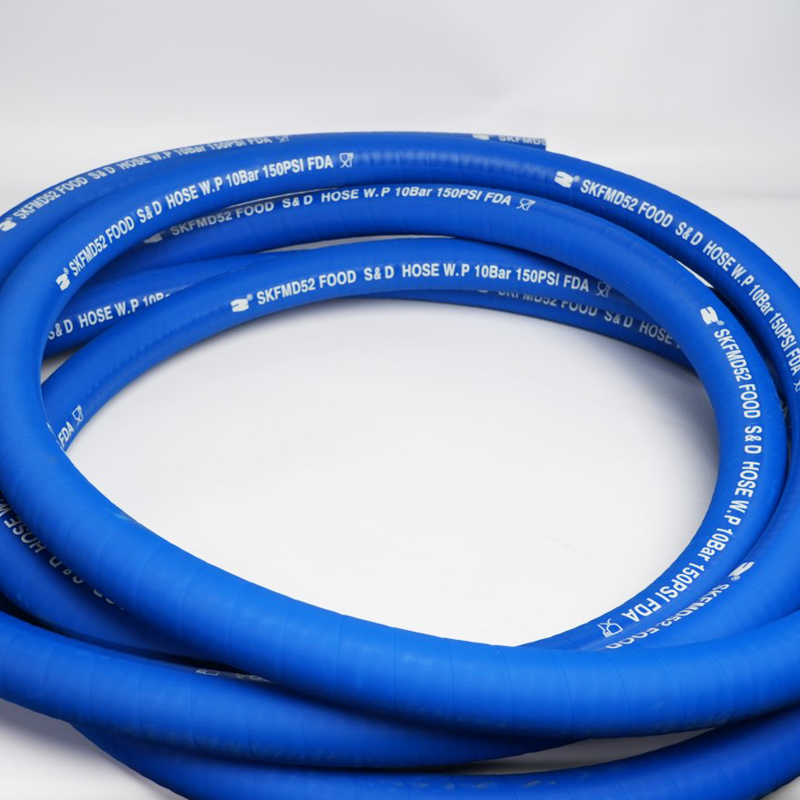
Assembly integrity and structural safety matter just as much as the core polymer material. Most industrial tubes utilize a specialized 3-layer architecture. The inner tube acts as the pure contact layer. The middle reinforcement provides structural strength. The outer cover delivers tough environmental protection. Every reliable food grade hose depends heavily on this combined structure.
However, the best inner tube remains completely useless if the fitting connection harbors bacteria. You must closely scrutinize the couplings. Require swaged or crimped sanitary fittings from your assembler. These specialized connections leave no internal step, crevice, or gap. Crevice-free couplings prevent microbial buildup. They also ensure incredibly smooth fluid dynamics.
Heavy, multi-reinforced assemblies present unique installation challenges. They can drag across wet floors. They pull aggressively on system joints. This mechanical stress eventually leads to fluid leaks. You must manage the physical weight carefully.
Calculate the precise bend radius required for your physical floor space. Bending a tube too sharply causes kinking. Kinking restricts fluid flow and creates internal friction points. It also permanently damages the reinforcement layer. If a line bends too sharply around a mixing tank, the inner wall folds. This fold creates a dead zone. Food particles become trapped inside. They easily survive standard CIP wash cycles, causing immediate contamination.
Operational best practices separate decent facilities from truly world-class operations. Visual risk management plays a huge role in preventing daily cross-contamination. You should use industry-standard color-coded outer covers throughout your plant.
For example, you can segregate dairy lines using white covers. You might identify raw meat lines using red covers. Allergen-free lines often utilize blue covers. This simple visual step prevents operators from mistakenly swapping critical transfer lines during a busy shift.
You must prioritize strict asset tracking over guesswork. The industry is rapidly moving away from "replace when leaking" strategies. A reactive approach guarantees eventual product loss. It also invites sudden safety hazards.
Instead, tag your assemblies with unique physical identifiers. RFID chips or etched stainless steel collars work perfectly. They allow your maintenance team to track cleaning cycles accurately. You can log installation dates and record maintenance events in your software.
Gradual internal degradation remains completely invisible from the outside. The implementation reality requires scheduled preventative replacement. You base these planned replacements on hard data tracking rather than visible failure. This proactive approach heavily protects plant compliance. It ensures consumer safety consistently. It ultimately prevents devastating emergency downtime.
Selecting appropriate transfer equipment represents a critical, multi-dimensional engineering decision. You must achieve perfect alignment between chemical compatibility, cleaning extremes, and strict sanitary coupling designs. Overlooking any single factor puts your entire production run at risk.
When evaluating potential partners, apply clear shortlisting logic. Prioritize suppliers who offer full compliance documentation instantly. Demand proof of their sanitary assembly testing procedures. They should also provide comprehensive lifecycle management support to protect your daily operations.
As a direct next-step action, we advise you to conduct a complete site audit of your current assets. Identify your most frequent recurring failure points on the plant floor. Then, consult a specialized industrial distributor. Work together to re-evaluate your specifications and upgrade your infrastructure safely.
A: Absolutely not. Standard garden hoses are typically made of lower-grade PVC containing lead or phthalate plasticizers that leach toxic chemicals into water. Always require an NSF-certified or FDA-approved food grade hose.
A: There is no universal timeline. Lifespan depends on chemical exposure, pressure cycles, and the frequency/harshness of CIP/SIP cleaning. Implementation of a routine inspection schedule (checking for stiffness, discoloration, or exterior wear) dictates replacement.
A: Brittleness and discoloration are usually signs of chemical incompatibility (e.g., using standard PVC for high-fat oils) or thermal degradation from cleaning temperatures exceeding the material's structural limits.