Views: 137 Author: Site Editor Publish Time: 2026-09-15 Origin: Site
Liquid food processing carries extremely high stakes. You know a single contamination event easily ruins entire production batches. Selecting the wrong transfer hose inevitably leads to product spoilage, catastrophic audit failures, and extended line downtime. Standard industrial hoses simply fail under these rigorous sanitary environments. You cannot use them because they trap dangerous bacteria and suffer from severe flavor scalping. Heavy chemical cleaning cycles also degrade standard polymers rapidly over time. Plant engineers and facility procurement managers desperately need reliable, compliant solutions. This guide provides a definitive, engineering-led framework for evaluating your sanitary transfer lines. You will learn exactly how to assess various rubber materials, decode strict compliance standards, and specify reliable assembly configurations. We give you the specific technical criteria necessary to protect your ultimate product integrity.
Material dictates lifespan: A food grade EPDM hose handles dairy fats and high temperatures, while silicone excels in flavor neutrality.
Compliance is verifiable: True FDA and 3-A certifications require traceable material documentation, not just a "food safe" label.
Assemblies are the weak link: 90% of bio-contamination occurs at the fittings, making sanitary crimping just as critical as the hose material itself.
CIP/SIP compatibility is non-negotiable: The hose must withstand your facility's specific chemical concentrations and thermal cycling.
Every component in your processing line requires intense scrutiny. Hoses often act as the most vulnerable points in your facility. Relying on inadequate materials introduces severe operational risks. You must understand how incorrect polymer selection directly threatens product safety.
Micro-abrasions form rapidly inside incompatible polymers. Frequent flexing and harsh chemical exposure create microscopic scratches along the inner tube. Bacteria like Listeria and E. coli actively hide inside these tiny crevices. Standard cleaning fluids cannot effectively penetrate these deep harbor points. Over time, bacteria multiply and form a resilient biofilm. This biofilm continually sheds pathogens into your passing liquid. Using a proper food grade hose prevents these dangerous micro-abrasions from forming prematurely.
Many facilities process multiple liquid profiles on the same production line. Poorly specified rubber acts like a sponge. It absorbs strong aromatic compounds from one batch. We call this phenomenon flavor scalping. For example, pumping root beer leaves heavy essential oils trapped in the rubber wall. When you pump sparkling water through the exact same line tomorrow, the water tastes like root beer. This cross-contamination ruins product consistency and triggers massive batch rejections.
Rubber chemistry dictates how materials react to different fluids. Animal fats present in dairy products aggressively attack standard rubber compounds. The inner tube swells, softens, and eventually begins flaking off directly into the product stream. Similarly, high-proof alcohol extracts plasticizers from incorrect polymers. This extraction causes the hose wall to become brittle and crack. You must match your specific process fluid to the correct engineered polymer to avoid catastrophic structural breakdown.
Industry certifications ensure public safety. However, many suppliers use generic terms loosely. You must distinguish between legitimate regulatory compliance and empty marketing claims. Strict verification protects your facility during sudden health audits.
Title 21 CFR 177.2600 governs rubber articles intended for repeated use. The FDA sets absolute maximum extraction limits for these rubber compounds. Manufacturers must test the material using distilled water and n-hexane. The material cannot leach toxic chemicals or heavy metals into the fluid stream. An authentic FDA food grade hose utilizes only approved, non-toxic ingredients during its compounding process. It also requires manufacturing in clean, strictly controlled environments.
Dairy processing typically demands a stricter certification level. The 3-A Sanitary Standard focuses heavily on surface finish and total cleanability. Standard 18-03 dictates specific smoothness requirements for the inner contact surface. The rubber must not exceed a certain microinch roughness threshold. This extreme smoothness guarantees your Clean-in-Place (CIP) systems can flush out all residual organic matter completely.
Never accept a generic "food safe" stamp on an invoice. You should operate as a highly skeptical buyer. Demand a formal Declaration of Compliance (DoC) before purchasing any sanitary transfer line. This document legally binds the manufacturer to their material claims. Furthermore, insist on complete batch traceability. The manufacturer should print a unique lot number directly on the hose layline. This lot number traces the exact rubber batch back to its original raw material testing data.
No single polymer solves every processing challenge. You must select the inner tube material based on your specific application demands. Understanding the strengths and weaknesses of each polymer prevents premature failures.
Engineers consistently specify EPDM for rugged, high-temperature environments. This material handles extreme alkaline and acidic CIP chemicals effortlessly. A properly cured food grade EPDM hose delivers exceptional resistance to animal fats and butterfat. It tolerates massive thermal shocks during daily wash cycles. The primary drawback involves its opacity. You cannot visually monitor the fluid flow through the dark rubber wall.
Silicone offers unparalleled purity levels. Platinum-cured silicone remains completely flavor-neutral under all conditions. Delicate beverages require this absolute neutrality to protect subtle tasting notes. Silicone also handles extreme thermal extremes, from freezing temperatures to high-heat sterilization. However, silicone possesses a notoriously weak physical structure. It remains highly susceptible to physical abrasion. Dragging a silicone line across a rough factory floor tears the outer jacket quickly.
Plastics like PVC provide excellent transparency and cost savings. Operators can easily monitor fluid movement and spot blockages visually. These materials work perfectly for transporting water, dry bulk powders, or low-fat ingredients. Unfortunately, they degrade rapidly under hot CIP processes. High-fat dairy exposure also destroys PVC quickly. You should restrict these materials strictly to low-temperature, low-fat applications.
Material Comparison for Sanitary Transfer
Material | Temperature Range | Fat Resistance | Best Application |
|---|---|---|---|
EPDM | -40°F to 300°F | Excellent | Dairy, CIP processes |
Silicone | -80°F to 400°F | Moderate | Delicate beverages, pure water |
PVC | -10°F to 140°F | Poor | Dry bulk, cold water |
Transferring raw milk presents completely different challenges than pumping craft beer. You must evaluate the specific chemical makeup of your product. Tailoring your specification to the exact fluid ensures long-term operational success.
Milk, heavy cream, and liquid butter contain very high fat concentrations. Standard rubber absorbs these animal fats rapidly. The polymer structure swells, loses tensile strength, and ultimately fails. Your selected dairy transfer hose must utilize an inner tube explicitly formulated for fat resistance.
Thermal shock presents another massive hurdle in dairy facilities. Chilled raw milk flows through the system at roughly 39°F. Shortly after, the Steam-in-Place (SIP) wash cycle blasts through the exact same line at 180°F to 212°F. The inner tube expands and contracts violently during these drastic temperature shifts. You must verify the manufacturer guarantees the material against thermal shock delamination.
Breweries, wineries, and juice plants face unique permeation risks. Alcohol acts as a powerful solvent. It permeates weak materials easily. Syrupy juice concentrates often stick aggressively to rough inner walls. A proper beverage transfer hose prevents both permeation and sugar adhesion.
Odor and taste neutrality remain the most critical factors here. Connoisseurs easily detect plastic chemical taints in wine or beer. The inner tube must leave absolutely zero residual taste behind. Platinum-cured silicone and ultra-high molecular weight polyethylene (UHMWPE) excel in these sensitive beverage environments.
Buying premium rubber solves only half your problem. The connection points represent the highest risk areas in your entire processing line. Poorly assembled fittings harbor dangerous bacteria and fail under pressure.
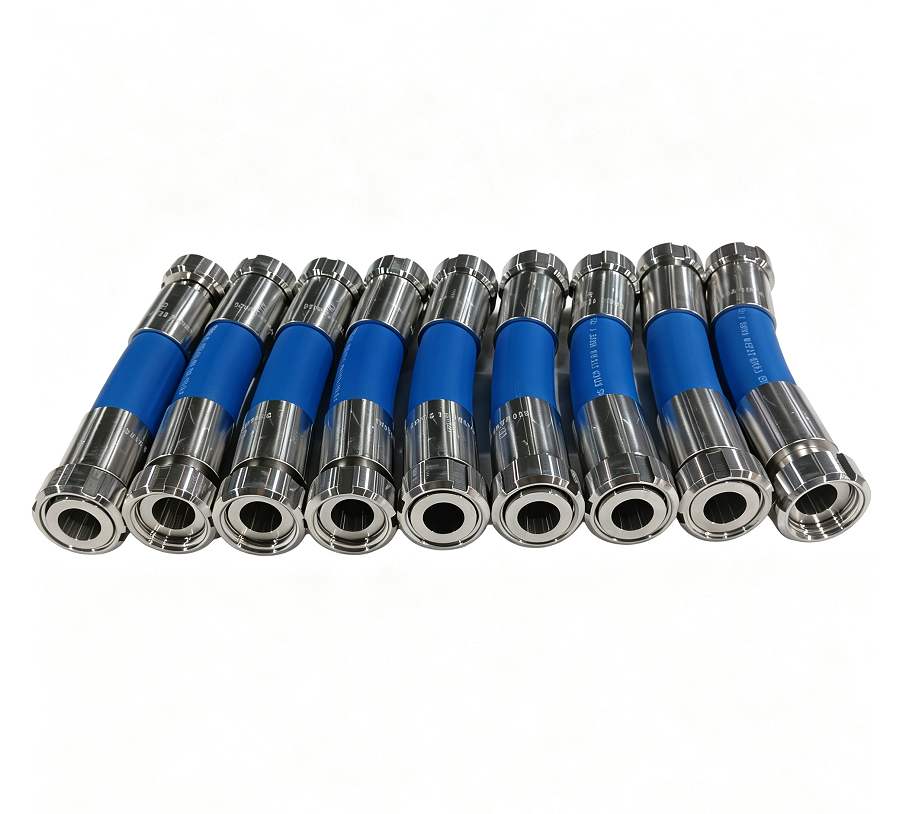
You cannot simply push a bare hose over a pipe and secure it using a metal band. Banding creates deep crevices between the fitting and the inner tube. Fluid pools in these hidden spaces and rots. Nearly 90% of all bio-contamination events occur directly at the fittings. You require professionally crimped stainless steel fittings. Sanitary crimping uses a specialized collar to compress the rubber evenly around a smooth ferrule. This process creates a perfectly flush, crevice-free transition. Tri-Clamp fittings remain the industry standard for preventing bacteria traps.
Cleaning regimens inflict severe punishment on your assemblies. During CIP cycles, massive pumps generate sudden pressure spikes. Harsh caustic chemicals flow through the line at high velocities. Steam cycles introduce extreme physical expansion. Over time, this dynamic stress attempts to push the fitting out of the rubber. The outer jacket also suffers physical stress from dragging across wet, chemical-covered floors. You need heavy-duty reinforcement layers to combat this daily abuse.
Even the best assemblies eventually wear out. You must establish rigorous visual inspection routines to catch failures early. Proactive replacement schedules prevent catastrophic mid-batch blowouts.
Implement this standard weekly inspection routine:
Inspect the outer cover for deep abrasions exposing the wire helix.
Check the transition point near the fitting for severe kinking or soft spots.
Examine the internal bore using a flashlight for discoloration or bubbling.
Verify all lot numbers remain legible for audit traceability.
Flex the assembly manually to feel for hidden structural wire damage.
Protecting your liquid food products requires diligent engineering choices. You cannot afford to compromise on sanitary transfer lines. A methodical approach guarantees safety and compliance.
Summarize your needs using the STAMPED method before contacting a supplier:
Size: Determine exact inner and outer diameters.
Temperature: Record your lowest product chill and highest CIP steam temperatures.
Application: Define the exact fluid, fat content, and factory environment.
Material: Select EPDM, Silicone, or PVC based on chemical compatibility.
Pressure: Note your maximum pump output and vacuum requirements.
Ends: Specify sanitary Tri-Clamp or specialty crimped fittings.
Delivery: Calculate necessary lengths and desired delivery schedules.
Your next step requires an immediate internal audit. Review your current CIP chemical concentrations and maximum SIP temperatures. Compare these figures against your existing hose specifications. Do not wait for a bacterial failure to force an upgrade. Reach out to a certified hose assembly specialist today to design a fully compliant, permanently safe sanitary system for your facility.
A: It must comply strictly with CFR Title 21 requirements. The rubber compound cannot contain toxic plasticizers or heavy metals. Manufacturers must pass specific extraction tests using distilled water and n-hexane. Furthermore, the factory environment itself must meet strict cleanliness and cross-contamination standards during production.
A: No. Beverage hoses often utilize materials designed for alcohol or sugar resistance. They usually lack the specific fat-resistant properties required for dairy. Pumping milk through a standard beverage line causes the rubber to absorb animal fats, swell rapidly, and break down into the product.
A: Replacement frequency depends heavily on your CIP/SIP harshness, operating pressure, and daily physical wear. Strict timelines rarely work. You must rely on regular visual and physical inspections. Replace the assembly immediately if you detect outer jacket cracking, inner tube discoloration, or soft spots near the crimped fittings.
A: High-quality, properly cured sanitary EPDM remains entirely flavor-neutral. It will not alter the taste of water or beer. However, you must flush and clean the new assembly thoroughly according to the manufacturer's precise CIP specifications before running your very first batch.