Views: 142 Author: Site Editor Publish Time: 2026-07-31 Origin: Site
The transition to high-density computing and AI workloads has made liquid cooling mandatory for many facilities, shifting the critical failure point from HVAC systems to the physical plumbing within the rack. A single failure in a cooling hose can result in catastrophic hardware damage, dielectric fluid leaks, or unplanned downtime. Selecting the wrong material leads to fluid degradation, micro-channel clogging, and premature system failure. Evaluating a data center cooling hose requires moving beyond basic pressure ratings to understand fluid chemistry compatibility, permeation rates, external cover resilience, and long-term mechanical stability. This guide breaks down the technical specifications required to select the right materials for a data center liquid cooling system.
Material dictates lifespan: Compatibility between the coolant (water, glycol, engineered dielectric fluids) and the hose inner tube is the primary predictor of long-term reliability.
Dual-layer defense is required: Material selection must account for both the inner tube (coolant compatibility) and the outer cover (environmental protection against abrasion, condensation, and chemical drips).
Purity prevents system degradation: Standard industrial rubber hoses may leach compounds into the coolant; platinum-cured silicone or specialized PTFE materials are required to prevent outgassing and cold-plate clogging.
Mechanical trade-offs are unavoidable: Facility engineers must balance the extreme durability, pressure tolerance, and vibration dampening of corrugated metal hoses against the flexibility and tight bend radius of elastomeric options.
Fittings are as critical as the hose: Material selection must account for the specific quick-disconnect (QD) or permanent fittings used in the loop to prevent galvanic corrosion and mechanical separation.
A successful implementation achieves zero leakage, maintains fluid purity over a 5-to-10-year lifecycle, absorbs system vibration, and accommodates rack maintenance without mechanical fatigue. Every component in the fluid path must operate flawlessly under continuous thermal and hydraulic stress. Engineers must evaluate how materials behave when subjected to constant flow rates, fluctuating temperatures, and the mechanical demands of server maintenance. We see this daily on the facility floor: a line that looks fine on day one can become brittle and crack by year three if the material isn't matched to the thermal load.
The shift from traditional raised-floor air cooling to direct-to-chip (D2C) and rear-door heat exchanger (RDHx) configurations fundamentally changes the risk profile of fluid transport. In legacy systems, water remained isolated in facility-level loops. Today, a data center liquid cooling hose routes coolant directly over sensitive CPUs, GPUs, and memory modules. This proximity removes any margin for error regarding leaks or condensation. You are running fluids inches away from critical silicon.
Primary failure mechanisms fall into several distinct categories that require specific engineering countermeasures:
Chemical degradation: Occurs when the coolant causes the inner tube to swell, harden, or shed particulates into the fluid stream.
Mechanical fatigue: Manifests as kinking, abrasion, or cracking due to improper routing, tight bend radii, or repeated movement during server maintenance.
Environmental factors: External ozone exposure, ambient heat, and continuous pump vibration accelerate material aging from the outside in.
Localized pressure spikes: Water hammer effects from rapid valve closures can rupture weakened lines if the burst pressure margins are insufficient.
Selecting the correct polymer or alloy forms the foundation of a reliable thermal management architecture. Each material offers distinct advantages and limitations based on the specific fluid chemistry and routing requirements. You cannot use a one-size-fits-all approach when dealing with high-density compute environments.
EPDM exhibits high resistance to heat, ozone, and weather. It provides superior resistance compared to a standard industrial rubber hose under harsh exposure. These characteristics make it highly suitable for facility-level chilled water loops and standard water/glycol mixtures where extreme flexibility is less critical. However, EPDM is generally incompatible with certain hydrocarbon-based dielectric fluids. If not specified as a high-purity variant, standard EPDM carries a potential for particulate shedding and swelling over time, which will clog cold plates.
Silicone offers extreme temperature tolerance, high flexibility, excellent bend radius, and superior resistance to long-term thermal aging. It excels in in-rack routing where tight spaces require maximum flexibility and kink-resistance. The primary limitation of silicone is its higher permeation rate, which can lead to gradual fluid loss over time. Furthermore, standard peroxide-cured silicone can cause outgassing. Facilities must specify platinum-cured silicone to ensure material purity and eliminate volatile byproducts that could contaminate the loop.
Constructed from stainless steel, corrugated metal hoses offer zero permeation, immunity to chemical degradation, and an excellent capability to withstand high operating pressures and continuous pump vibrations. They are best deployed in high-pressure manifolds, under-floor routing, and environments subject to mechanical vibration or corrosive external chemicals. The trade-off is rigidity; they require precise measurement and installation. They are also susceptible to fatigue if subjected to improper torsional stress or multi-axis movement during installation.
PTFE delivers near-universal chemical compatibility, ultra-low friction, high purity, and complete resistance to aging and cracking. These traits make it ideal for systems utilizing aggressive engineered dielectric fluids or two-phase immersion cooling fluids. While highly effective, PTFE is stiffer than silicone and requires specialized crimping and custom fittings compared to a standard industrial rubber hose. The installation requires trained personnel to ensure the fittings are seated correctly without damaging the inner core.
Material | Primary Advantage | Main Limitation | Best Use Case |
|---|---|---|---|
EPDM | Excellent heat and ozone resistance | Incompatible with hydrocarbon fluids | Facility-level water/glycol loops |
Platinum-Cured Silicone | Extreme flexibility and purity | Higher permeation rates | In-rack D2C routing |
Corrugated Metal | Zero permeation, high pressure tolerance | Rigid, susceptible to torsional fatigue | Main manifolds, vibration isolation |
PTFE | Universal chemical compatibility | Stiff, requires specialized fittings | Aggressive dielectric fluids |
Translating material properties into operational outcomes requires a deep understanding of fluid dynamics, mechanical stress, and chemical interactions within the specific environment. You have to look at the entire system, not just the spec sheet of a single component.
The chemical interaction between inner tubes and specific fluids dictates system longevity. Propylene glycol (PG) and ethylene glycol (EG) mixtures, treated water, and fluorochemicals all interact differently with elastomers. The inner tube must remain inert when exposed to the coolant. Simultaneously, outer covers must resist external environmental hazards, including ozone, condensation, and chemical drips. If the outer cover fails, environmental factors will degrade the structural reinforcement layers. Incompatible materials lead to elastomer swelling, plasticizer extraction, and eventual rupture, releasing fluid directly into the server chassis.
Engineers must differentiate between operating pressure, proof pressure, and burst pressure. Operating pressure defines the normal steady-state condition. Proof pressure is the testing threshold, while burst pressure is the point of catastrophic failure. Materials must handle hydraulic shock, commonly known as water hammer, which occurs when valves close rapidly. Additionally, continuous high-frequency vibration from pumps and chillers can cause work-hardening in rigid lines or abrasion in flexible lines. Proper material selection dampens these vibrations, protecting delicate cold plate connections.
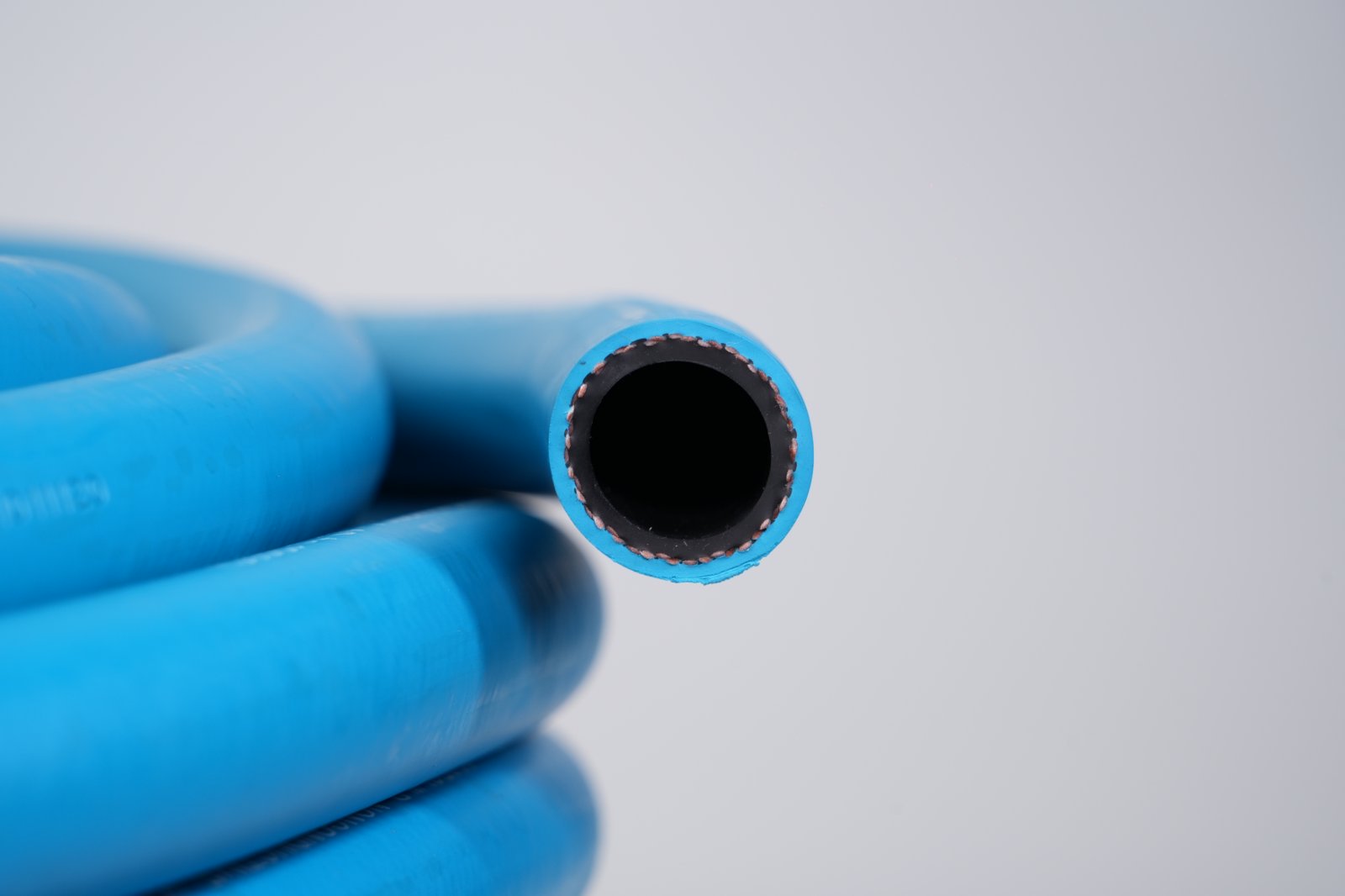
Minimum Bend Radius (MBR) directly impacts rack density. A smaller MBR allows for tighter routing between servers and manifolds without stressing the connection points. Long-term mechanical resilience depends on how engineered high-flex designs resist kinks, cracks, and aging under continuous thermal load. Kinking restricts flow, causing localized thermal events at the server level. Wire-reinforced designs provide a robust solution for tight routing, maintaining the internal diameter even when bent to the absolute minimum radius.
Vapor transmission through the wall, known as permeation, leads to gradual coolant loss and air ingress. Air in the loop reduces thermal transfer efficiency and promotes biological growth or oxidation. Outgassing presents an equally severe operational risk. When leached chemicals from standard materials precipitate out of the fluid, they clog the micro-skived fins inside CPU and GPU cold plates. Maintaining strict material purity prevents this degradation.
Strategic procurement requires analyzing the complete lifecycle of the infrastructure. The initial acquisition represents only a fraction of the overall operational impact. Evaluating the long-term performance involves understanding maintenance intervals and risk mitigation.
Comparing the low upfront acquisition of standard EPDM against the extended lifespan and reduced maintenance overhead of PTFE or metal assemblies reveals significant operational differences. Premium materials resist thermal aging and chemical breakdown much longer, extending the operational window before mandatory replacements. Facilities must establish realistic replacement schedules based on actual material degradation curves and continuous thermal aging rather than relying solely on generic manufacturer warranties.
Downtime risk valuation plays a critical role in material selection. Utilizing premium, application-specific materials acts as a safeguard against catastrophic hardware replacement and severe service level agreement (SLA) penalties. A single leak or flow restriction can destroy hundreds of thousands of dollars in high-density compute hardware. Investing in high-purity, chemically compatible routing components ensures continuous uptime and protects the core infrastructure.
Even the highest quality materials will fail if integrated improperly. Execution during the installation phase determines the ultimate reliability of the thermal management architecture. We follow specific protocols on-site to ensure the physical installation doesn't compromise the material integrity.
Audit the entire wetted path to identify potential galvanic couples between dissimilar metals.
Verify that all quick-disconnect seals match the chemical profile of the primary tube material.
Implement strict routing guidelines to prevent torsional stress during installation.
Install engineered flexible segments to isolate pump vibration from the rigid manifold infrastructure.
Field-installed push-on fittings introduce a significant risk of leaks and blow-offs under pressure surges. Mitigation requires mandating factory-crimped assemblies. Furthermore, engineers must ensure strict compatibility between the tube material and the Quick Disconnect (QD) seals, such as Viton or EPDM. A mismatch here causes seal degradation and immediate leakage at the connection point.
Forcing a line into a twisted position during installation creates torsional stress, dramatically reducing its burst strength and lifespan. Mitigation involves implementing strict routing guidelines. Installers should use swivel fittings to prevent twisting, particularly with corrugated metal and PTFE variants. Engineered flexible segments should be utilized to isolate pump vibration from the rigid manifold infrastructure.
When dissimilar metals interact within a conductive fluid environment, galvanic corrosion rapidly degrades the components. Mitigation requires a comprehensive audit of the entire wetted path. Engineers must ensure the metal braid, the fittings, and the manifold materials do not create a galvanic couple in the presence of the chosen coolant. Utilizing dielectric unions or standardizing metal types across the loop prevents this electrochemical degradation.
There is no single universal solution for fluid routing in high-density environments; selection depends entirely on specific coolant chemistry, operating pressure, system vibration, and the spatial constraints of the rack architecture. Default to platinum-cured silicone for tight in-rack water and glycol routing to ensure purity and flexibility. Specify PTFE for aggressive dielectric fluids that would otherwise degrade standard elastomers. Utilize corrugated metal for high-pressure facility-to-rack distribution and critical vibration isolation.
Request comprehensive material compatibility charts directly from fluid manufacturers before finalizing any hardware specifications.
Conduct localized pressure and vibration testing on sample assemblies to verify performance under actual site conditions.
Consult with specialized assembly manufacturers to review exact routing schematics and identify potential torsional stress points.
Audit all planned fittings and quick-disconnect seals to ensure they match the chemical profile of the primary tube.
A: EPDM offers excellent durability and ozone resistance for facility-level water loops but lacks compatibility with certain engineered fluids. Silicone provides superior flexibility and extreme temperature tolerance, making it ideal for tight in-rack routing, though it has higher permeation rates than EPDM.
A: Platinum curing eliminates the volatile byproducts associated with standard peroxide-cured silicone. This prevents outgassing and leaching, ensuring the coolant remains pure and preventing the micro-channels inside server cold plates from clogging over time.
A: No. Standard industrial rubber compounds often contain plasticizers and fillers that react poorly with engineered dielectric fluids. This interaction causes the material to swell, harden, and shed particulates, leading to leaks and catastrophic system blockages.
A: The outer cover protects the structural reinforcement layers and the inner tube from external environmental hazards. It must resist ambient heat, ozone degradation, physical abrasion from rack edges, and potential chemical drips from maintenance activities.
A: Kinking occurs when the line is bent beyond its Minimum Bend Radius (MBR), while cracking results from thermal aging or chemical degradation. A kink restricts fluid flow, immediately reducing thermal transfer and causing rapid, localized overheating at the server level.
A: Permeation is the microscopic transmission of vapor through the material wall. In closed-loop systems, high permeation rates lead to gradual coolant loss and allow air to enter the system, which reduces cooling efficiency and encourages biological growth.